
A hospital visit is not a single destination. It’s a series of stops that begins at home and is marked with questions at every step: which entrance, where to park, registration, investigations, doctor consultations and more.
Each of these steps is also marked with the challenge of how the person could find their way to that particular place within the hospital. The signage can only serve so much, guiding from the entrance to the commonly visited areas. When a person is already inside the hospital at a point A, the signage often fails to guide the person from point A to point B.
The patient moves through these challenges semi-blind and is forced to rely on asking a stranger for directions: receptionist, security guard, nurse, or somebody else. In larger campuses, one might have to ask for directions multiple times before eventually arriving at their desired point B.
Three investigations often mean three registrations and three separate waits, scattered across floors and wings. A 20-minute wait for the first, a 45-minute wait for the second, and a 15-minute wait for the third all get added up, serially, rather than being managed in parallel.
The cognitive load being demanded of the patients and their caregivers is being wasted in navigating the hospital system (both physical and figurative navigation) instead of being used in understanding their health condition and getting well.
The uncertainties, stresses and wasted time accumulate, negatively affecting the experience and causing distress to the patients and the caregivers.
What we offer
Our solution consists of two main components that can work together.
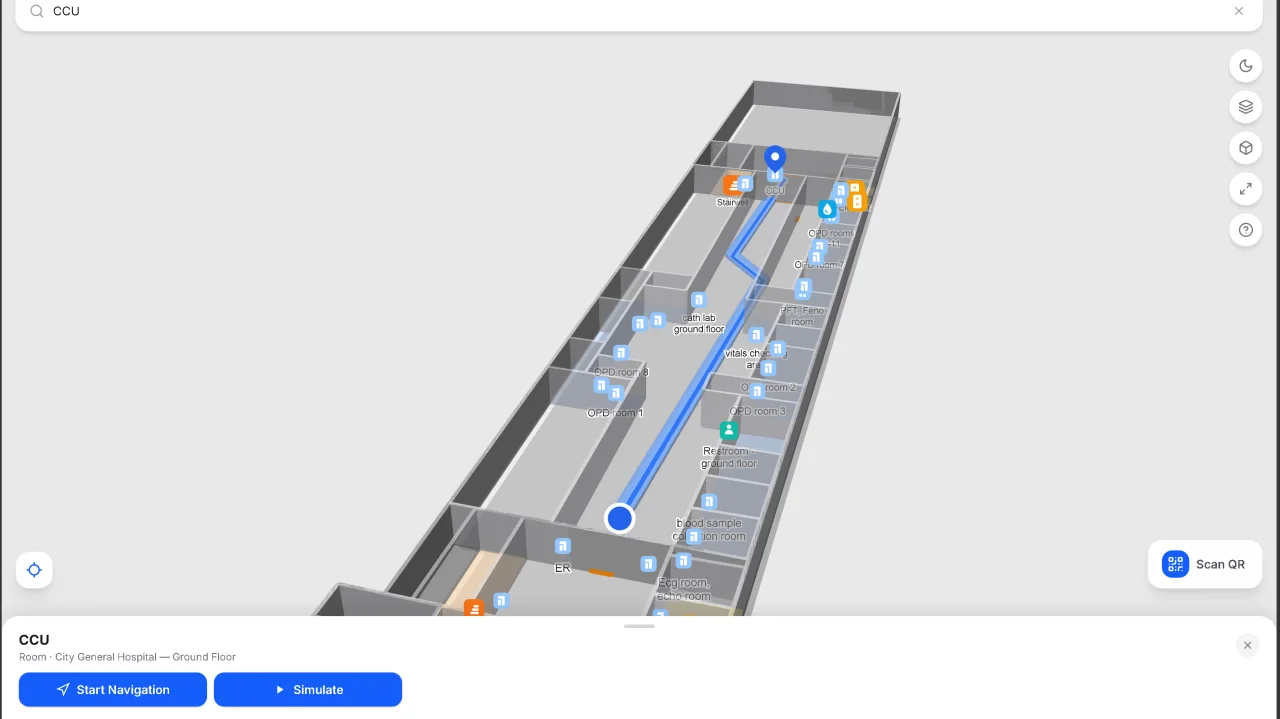
The first component is an Indoor Navigation System that can be used in a similar way to how popular map apps like Google Maps, Waze and others are used for navigating outdoors.
Users would access our solution from their smartphones through a web app or mobile application. The user interface would be similar to popular map apps like Google Maps, with some thoughtfully designed differences that enable this to work well with the needs and constraints of the indoor environment of a hospital.
The second component is a Remote Token Tracking System that helps the patient plan, manage and track their journey in the hospital.
When a person registers for an investigation or a consultation, or for multiple investigations, our app allows them to remotely track the queue status for all the investigations and consultations they have registered for, and suggests a plan for the optimal sequence to do them, considering:
- their current location within the hospital
- distance and route to each stop
- their token status in each of these queues
- medically informed constraints
An example
A follow-up patient is looking to give fasting blood samples for Fasting Blood Sugar and Lipid Profile, then have breakfast, then give a sample for Post Prandial Blood Sugar (2 hours after the meal), and also get an ECG and ECHO done.
Our app helps the patient navigate optimally through all of these steps, taking into account the necessary logical sequence, the distances and routes to each of the areas, whether the patient is looking to have breakfast from the canteen or elsewhere, the number of patients already waiting in queue for ECG and ECHO, and whether ECG and ECHO can be fit in during the wait for giving the Post Prandial sample.
These two components are designed to work in synergy with each other and provide a unified, seamless interface for the patient to have the smoothest hospital visit.
You can see both components working together in our live hospital demo.